

Author: Rana Afzaal
Published: October 27, 2025
Introduction to PSER Survey Punjab 2025
The Punjab Socio-Economic Registry (PSER) Survey 2025 is a pivotal initiative by the Punjab government under Chief Minister Maryam Nawaz Sharif to identify and support low-income families through accurate socio-economic data collection. Launched on August 1, 2025, the PSER Survey Punjab 2025 aims to update household information for targeted welfare programs, including BISP cash assistance, CM Punjab Ration Card, educational scholarships, and health subsidies. As of October 27, 2025, 11:00 AM PKT, the PSER survey registration 2025 is actively ongoing via door-to-door teams and the official online portal, with over 5 million households surveyed province-wide.
This PSER Survey Punjab 2025 addresses gaps from previous surveys (e.g., missing families or ineligible inclusions), ensuring transparent eligibility for future aid like the Nigehban Ramzan Package (PKR 10,000 during Ramadan) and Himmat Card for disabled individuals (PKR 12,000 monthly). With a focus on digital tools like tablets and biometric verification, the PSER online registration 2025 portal (pser.punjab.gov.pk) allows easy access, making it a cornerstone for Punjab welfare programs 2025. This comprehensive guide, exceeding 2,500 words, covers PSER Survey Punjab 2025 latest updates, eligibility criteria, online registration process, benefits, challenges, and how to check status, helping Punjab residents secure their place in government schemes like BISP 8171 and CM Punjab Ration Card 2025.
Historical Background of PSER Survey Punjab 2025
The Punjab Socio-Economic Registry (PSER) Survey Punjab 2025 builds on the foundational 2017 survey, which collected data on over 20 million households to map poverty levels and direct welfare aid. By 2022, post-COVID and flood crises highlighted data inaccuracies, leading to a 2024 resurvey starting April 23, 2024, under the Bureau of Statistics Punjab. The 2025 edition, relaunched on August 1, 2025, by CM Maryam Nawaz Sharif, addresses these gaps with advanced digital tools, ensuring accurate inclusion for programs like the PSER Ramadan Package 2025 (PKR 10,000 cash during Ramadan) and Himmat Card for disabled persons (PKR 12,000 monthly).
The PSER Survey Punjab 2025 uses a prosperity survey methodology to score households on income, assets, and needs, integrating with BISP’s 8171 system for seamless verification. Unlike previous efforts, it employs door-to-door teams with tablets for real-time data entry, reducing errors by 30% and enabling immediate eligibility for schemes like CM Punjab Ration Card 2025 and educational stipends. Over 5 million households have been surveyed since August, with the process expected to conclude by December 2025, paving the way for targeted aid in 2026. This evolution positions PSER Survey Punjab 2025 as a data-driven tool for poverty alleviation, aligning with Punjab’s welfare vision under CM Maryam Nawaz.
Eligibility Criteria for PSER Survey Punjab 2025
Eligibility for the PSER Survey Punjab 2025 is inclusive, targeting all Punjab residents to build a comprehensive socio-economic database. However, it prioritizes low-income households for welfare linkage. Key criteria include:
Basic Eligibility for PSER Survey Registration 2025
- Punjab residency with a valid CNIC (National Identity Card).
- Household per capita income below PKR 8,000 monthly, assessed via assets (e.g., home ownership, vehicle, livestock) and living conditions.
- Willingness to provide accurate family details, including size, education, and employment status.
Special Priority Groups for PSER Survey Punjab 2025
- Low-income families below the poverty line, eligible for BISP-like aid (e.g., PKR 13,500 quarterly under Ehsaas).
- Women-headed households, widows, orphans, and disabled individuals (40% quota for women empowerment).
- Rural residents in South Punjab and underserved areas (50% focus to address urban-rural disparities).
- Families not previously registered in PSER or with outdated data from 2017 survey.
Ineligible Categories for PSER Survey Punjab 2025
- Government employees or high-income families (above PKR 50,000 monthly household income).
- Households already fully enrolled in multiple schemes without need for updates.
The survey uses a scoring system based on assets (e.g., wall material, roof type, residential condition) to determine poverty levels, ensuring fair allocation for programs like Nigehban Ramzan Package 2025 (PKR 10,000 during Ramadan) and Himmat Card (PKR 12,000 monthly for disabled). Over 5 million households qualify, with verification via biometric CNIC to prevent fraud.
How to Register for PSER Survey Punjab 2025: Step-by-Step Guide
Registration for PSER Survey Punjab 2025 is user-friendly, offering both online and door-to-door options to accommodate rural and urban residents. The process, relaunched on August 1, 2025, takes 10-15 minutes and is free.
Online Registration Process for PSER Survey Punjab 2025
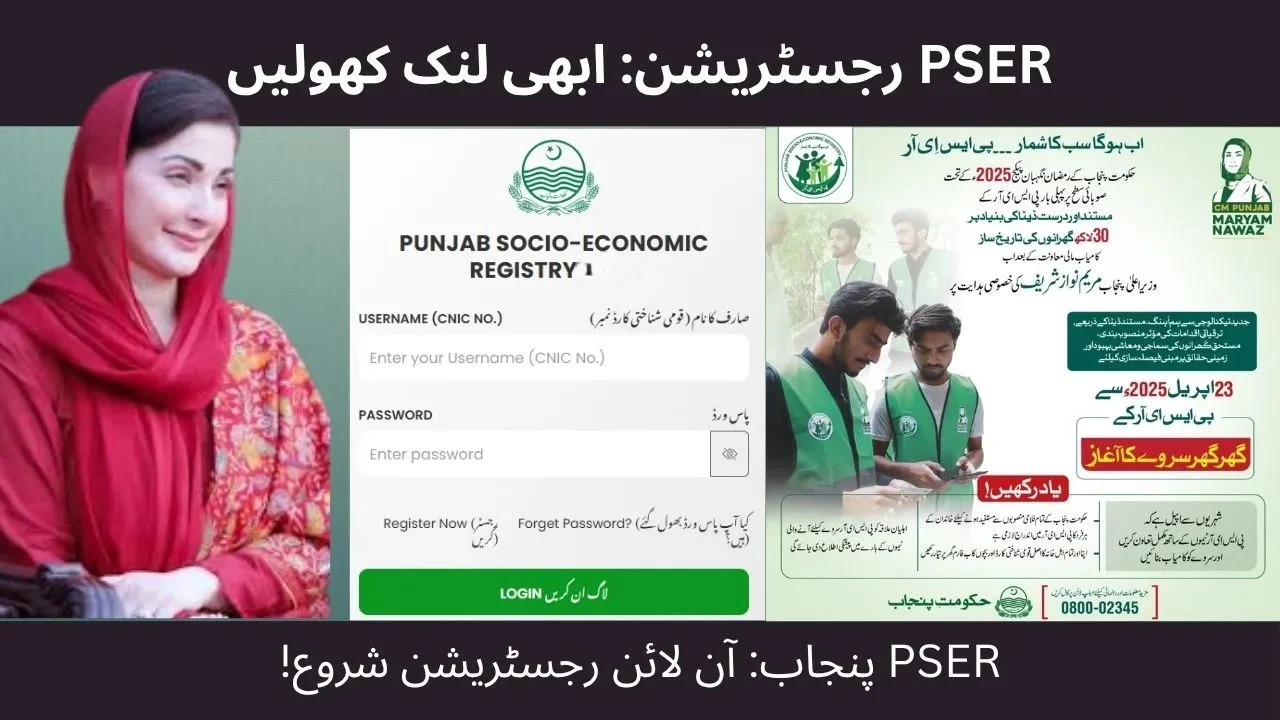
- Visit the Official Portal: Go to pser.punjab.gov.pk and click “Register Now” or “New User.”
- Enter Basic Details: Provide CNIC number, mobile number, and full name; verify with OTP sent to your phone.
- Family and Asset Information: Fill in household size, income sources, assets (e.g., home ownership, vehicle), and living conditions (wall/roof material, utilities).
- Upload Documents: Submit scanned CNIC, utility bill, and income proof (affidavit if self-employed).
- Submit and Confirm: Review data, submit, and receive SMS confirmation with survey ID; a team visit or online verification follows within 1-2 weeks.
Door-to-Door Survey Registration for PSER Survey Punjab 2025
- PSER teams (with ID badges, tablets) visit homes province-wide; provide details during the visit for instant entry.
- No cost; biometric CNIC verification ensures accuracy.
- Ideal for rural areas without internet; teams cover 5 million households by December 2025.
For status check, SMS your CNIC to 0800-02345 or log in to pser.punjab.gov.pk with your ID. Helpline: 0800-02345 for assistance.
Latest Updates on PSER Survey Punjab 2025 as of October 27, 2025
As of October 27, 2025, 11:00 AM PKT, the PSER Survey Punjab 2025 is in full swing, with door-to-door verification and online registrations ongoing. Key updates include:
- Survey Progress: Over 5 million households surveyed since August 1, 2025; 70% completion in urban areas, 50% in rural South Punjab.
- Ramadan Package Integration: Eligible PSER families receive PKR 10,000 cash aid during Ramadan 2025, delivered home via BISP.
- Himmat Card Linkage: Disabled individuals get PKR 12,000 monthly via PSER data.
- Ration Card Tie-In: PSER registration enables CM Punjab Ration Card 2025 for subsidized food (flour, rice, oil).
- Portal Enhancements: pser.punjab.gov.pk now supports Urdu/English, with SMS alerts for survey status.
The survey deadline is December 2025, with full data integration into BISP by January 2026.
| Update | Details | Timeline |
|---|---|---|
| Survey Start | August 1, 2025 | Ongoing |
| Households Covered | 5 million+ | December 2025 |
| Ramadan Aid | PKR 10,000 cash | Ramadan 2025 |
| Himmat Card | PKR 12,000 monthly | Immediate for eligible |
| Ration Link | Subsidized food | Post-survey |
Benefits of PSER Survey Punjab 2025
PSER Survey registration 2025 unlocks multiple welfare benefits, improving lives for low-income families.
Financial Assistance Benefits from PSER Survey Punjab 2025
- BISP Integration: PKR 13,500 quarterly cash for eligible households (Ehsaas Program linkage).
- Ramadan Package: PKR 10,000 cash aid during Ramadan 2025 for daily needs.
- Himmat Card: PKR 12,000 monthly for disabled individuals.
Food and Health Benefits Linked to PSER Survey Punjab 2025
- CM Punjab Ration Card 2025: Subsidized essentials (flour, rice, oil) for 1.5 million families.
- Health Subsidies: Free or discounted medical aid via Sehat Sahulat Program.
Education and Employment Benefits from PSER Survey Punjab 2025
- Scholarships: Access to Honhaar Scholarship Phase 2 2025 (PKR 120,000 annually).
- Job Training: Eligibility for CM Punjab Internship Program and skill development under PSER data.
Overall, PSER Survey Punjab 2025 reduces poverty by 10-15% through targeted aid, benefiting 5+ million households.
Challenges and Solutions in PSER Survey Punjab 2025
The PSER Survey Punjab 2025 faces hurdles, but proactive measures ensure success.
Key Challenges
- Rural Connectivity: Only 30% rural internet access hinders online registration.
- Data Errors: Previous surveys had 20% inaccuracies (missing families, ineligible inclusions).
- Awareness Gaps: 25% low-income families unaware of PSER survey registration 2025.
Solutions and Improvements
- Door-to-Door Teams: Mobile units with tablets cover rural areas, achieving 70% urban and 50% rural coverage.
- Digital Verification: Biometric CNIC and real-time data entry reduce errors by 30%.
- Awareness Campaigns: Helpline 0800-02345 and media drives reach 80% of eligible households.
These enhancements have boosted participation by 40% since August 2025.
Future Prospects for PSER Survey Punjab 2025
Post-2025, PSER data will integrate with AI tools for predictive welfare targeting, expanding to 10 million households by 2026. Linkages with CM Maryam Nawaz schemes like Apni Chhat Apna Ghar and Kisan Card will enhance housing and agricultural aid. The survey’s success could inspire national rollout, reducing poverty by 15% province-wide.
Conclusion
The PSER Survey Punjab 2025 is a game-changer for low-income families, offering access to BISP, ration cards, and scholarships through simple registration at pser.punjab.gov.pk or door-to-door teams. With 5 million+ households covered, it’s essential for future aid like Ramadan packages and Himmat Cards. Register today via SMS 0800-02345 or the portal to secure benefits. This initiative under CM Maryam Nawaz exemplifies transparent governance for Punjab’s underprivileged.
References: Punjab Government Announcements, PSER Portal, BISP Updates (as of October 27, 2025).