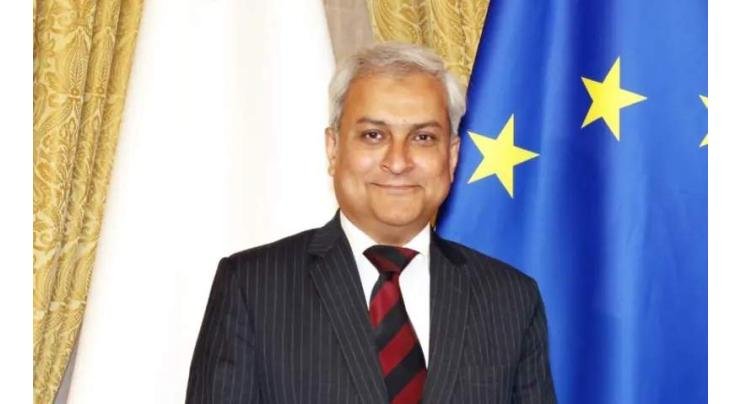

Pakistan is actively engaging regional and international partners to enhance restraint and diplomacy amid escalating hostilities in the Middle East, while reaffirming Islamabad’s commitment to regional peace and stability, Foreign Ministry Spokesperson Ambassador Tahir Andarabi said on Thursday.
ISLAMABAD (UrduPoint / Pakistan Point News – 12 March 2026) Pakistan is actively working with regional and international partners to enhance restraint and diplomacy amid the escalating hostilities in the Middle East, while reaffirming Islamabad’s commitment to regional peace and stability, Foreign Ministry Spokesperson Ambassador Tahir Andrabi said on Thursday.
In his speech at the weekly press conference at the Ministry of Foreign Affairs, Ambassador Andrabi highlighted Pakistan’s diplomatic efforts since the outbreak of violence in the region, stressing that the country has consistently called for respect for sovereignty, adherence to international law, and renewed dialogue to prevent further escalation.
The Foreign Ministry spokesman said that Prime Minister Shehbaz Sharif left on a one-day official visit to Saudi Arabia, accompanied by Deputy Prime Minister and Foreign Minister Ishaq Dar, where he will meet Crown Prince Mohammed bin Salman. He added that the visit comes within the framework of ongoing coordination between Pakistan and Saudi Arabia on regional peace and security and efforts to end the current cycle of violence.
He said that Pakistan strongly condemned the attacks on the Islamic Republic of Iran as well as the retaliatory strikes launched by Iran on several Gulf countries including Saudi Arabia, Bahrain, Jordan, Kuwait, Qatar and the United Arab Emirates, describing them as violations of sovereignty that could further destabilize the region.
He also expressed concern about the attacks targeting Türkiye and Azerbaijan, noting that such actions violate international law and threaten to expand the scope of the conflict.
The spokesman said that the Pakistani leadership has maintained intense diplomatic engagement since the escalation began on February 28, including a series of phone calls by the Prime Minister with the leaders of Saudi Arabia, Qatar, Jordan, Bahrain, Oman, Turkey, Lebanon, Malaysia and Azerbaijan to coordinate efforts to stop the escalation.
Likewise, he said Foreign Minister Ishaq Dar has remained in close contact with his regional and international counterparts, including multiple talks with Iranian Foreign Minister Seyed Abbas Araqchi and other leaders from the Gulf, Central Asia and beyond to promote dialogue and a peaceful resolution of the crisis.
Ambassador Andrabi confirmed that two Pakistani citizens lost their lives in the United Arab Emirates during the ongoing hostilities. He said that Pakistani missions in the UAE facilitated the repatriation of the deceased and helped the bereaved families.
He added that the Ministry of Foreign Affairs has activated its crisis management unit working around the clock, while Pakistani diplomatic missions across the region have established facilitation offices, helplines and registration portals to assist stranded Pakistani citizens with travel arrangements and consular support.
In response to a question about mediation, Andarabi said that Pakistan’s role focuses on advocating for three main principles: respect for sovereignty and territorial integrity, adherence to the UN Charter and international law, and renewed diplomatic engagement to resolve the crisis peacefully.
Regarding Afghanistan, he reiterated Pakistan’s demand to obtain verifiable guarantees from Kabul that its territory will not be used to carry out terrorist activities against Pakistan. “Since such assurances are not received, Pakistan will continue to follow its current policy,” he said, adding that Islamabad reserves the right to respond in self-defense against cross-border attacks.
The spokesman also expressed concern about the recent uranium supply agreement between Canada and India, saying the arrangement represents a selective exception in civil nuclear cooperation and could undermine the global non-proliferation regime.
He warned that confirmed uranium supplies could allow India to divert domestic reserves for military purposes, which could accelerate the expansion of its nuclear arsenal and exacerbate the strategic imbalance in South Asia.
Reiterating Pakistan’s position, Andarabi said that civil nuclear cooperation must be based on a non-discriminatory and standards-based approach that applies to all countries outside the framework of the Nuclear Non-Proliferation Treaty.
He added, “Selective exceptions weaken the credibility of the global non-proliferation architecture and threaten to destabilize regional and international peace and security.”